
By Antoine Genest-Gregoire, Assistant Professor at the University of Sherbrooke’s Department of Taxation. He is also a member of the Canadian Tax Observatory’s advisory committee.
Finance Minister Eric Girard presented his eighth budget on March 18th, 2026. This is the last budget that will be tabled before Quebecers go to the polls on October 5th. This is also the last budget of outgoing Premier François Legault who announced recently that he was stepping down as party leader. His replacement as leader of Coalition Avenir Québec will be elected on April 12th. Communication about this year’s budget was heavily focused on continuity and “leaving the house in order”, as Girard has often described the financial challenge he himself inherited 8 years ago.
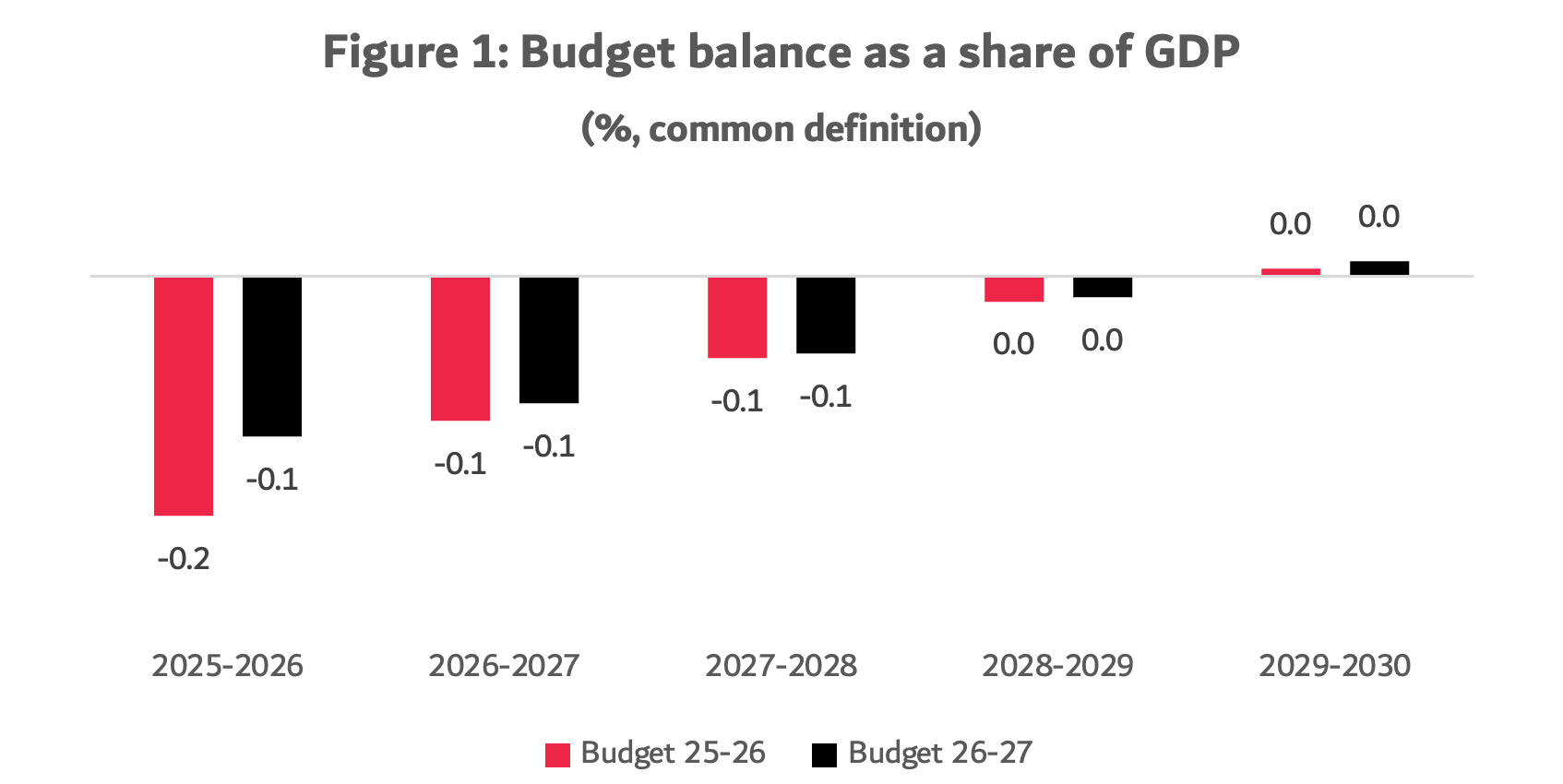
Québec’s balanced budget law has forced the government to focus on bringing back surpluses. Girard presented his five-year plan to do so in the previous budget. It included plans to reduce the growth of public spending, plans for crown corporations to bring in more revenue, changes to tax expenditures and a renewed plea for increased transfers from the federal government. Thanks to greater-than-expected revenue from taxes, the situation in this year’s budget is a little better than in the previous one, as shown in Figure 1.
The budget includes a limited number of new tax and spending measures totaling approximately 2B$ in 2026-2027. These include the yearly cost of a 3 per cent cap on the growth of the property school tax, subsidies for 5000 previously private childcare spots and funding to build 1000 affordable homes. The government also announced an automatic tax filing program similar to the one introduced by the federal government in its 2025-2026 budget last fall. The aims are the same: automatically filing taxes for individuals who may have not filed recently, so that they can be eligible for tax-provided income support. Revenu Québec, the province’s tax collection agency, has not yet specified the eligibility criteria or the delays of application for the new program. Pending changes to tax legislation, it will be in effect for tax year 2026.
Québec also has a law that forces it to devote some of its budget to a sovereign wealth fund called the Generations Fund. The Fund’s objective is to reduce intergenerational inequality stemming from the province’s quickly aging population. That law dictates that the government’s net debt, including the assets of the Generations Fund, reaches a level of 35.5 per cent of GDP by 2032-2033 and 32.5 per cent in 2037-2038.
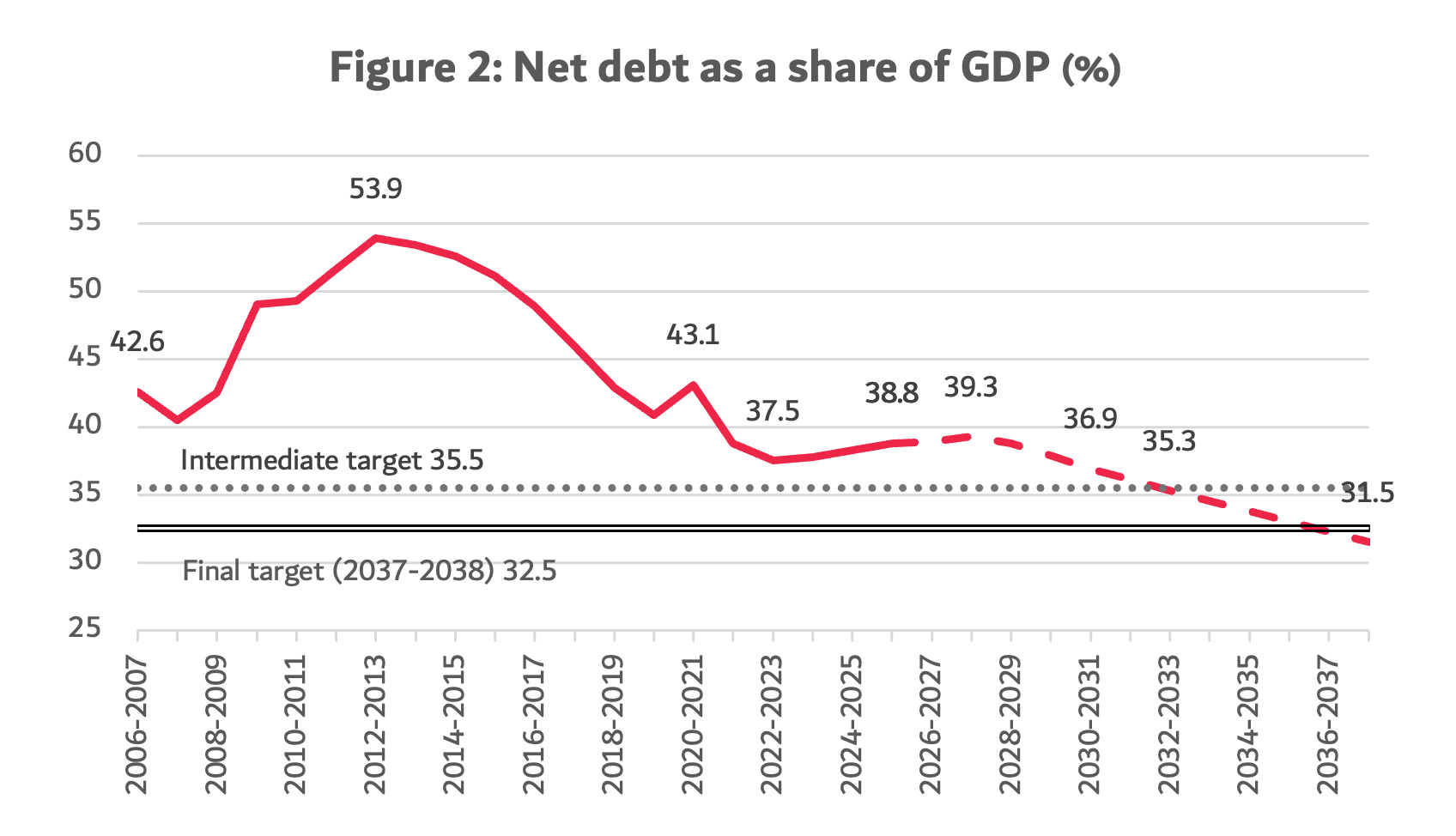
The government is still on track to reach these targets, if its plan to bring the budget back to balance succeeds. Figure 1 shows Québec’s budget balance according to the same definition used by other provinces and the federal government. However, the additional funding required for contributions to the Generations Fund means that the government needs to target an accounting surplus rather than simply a balanced budget, meaning that the funding gap is larger, as shown in Figure 3.
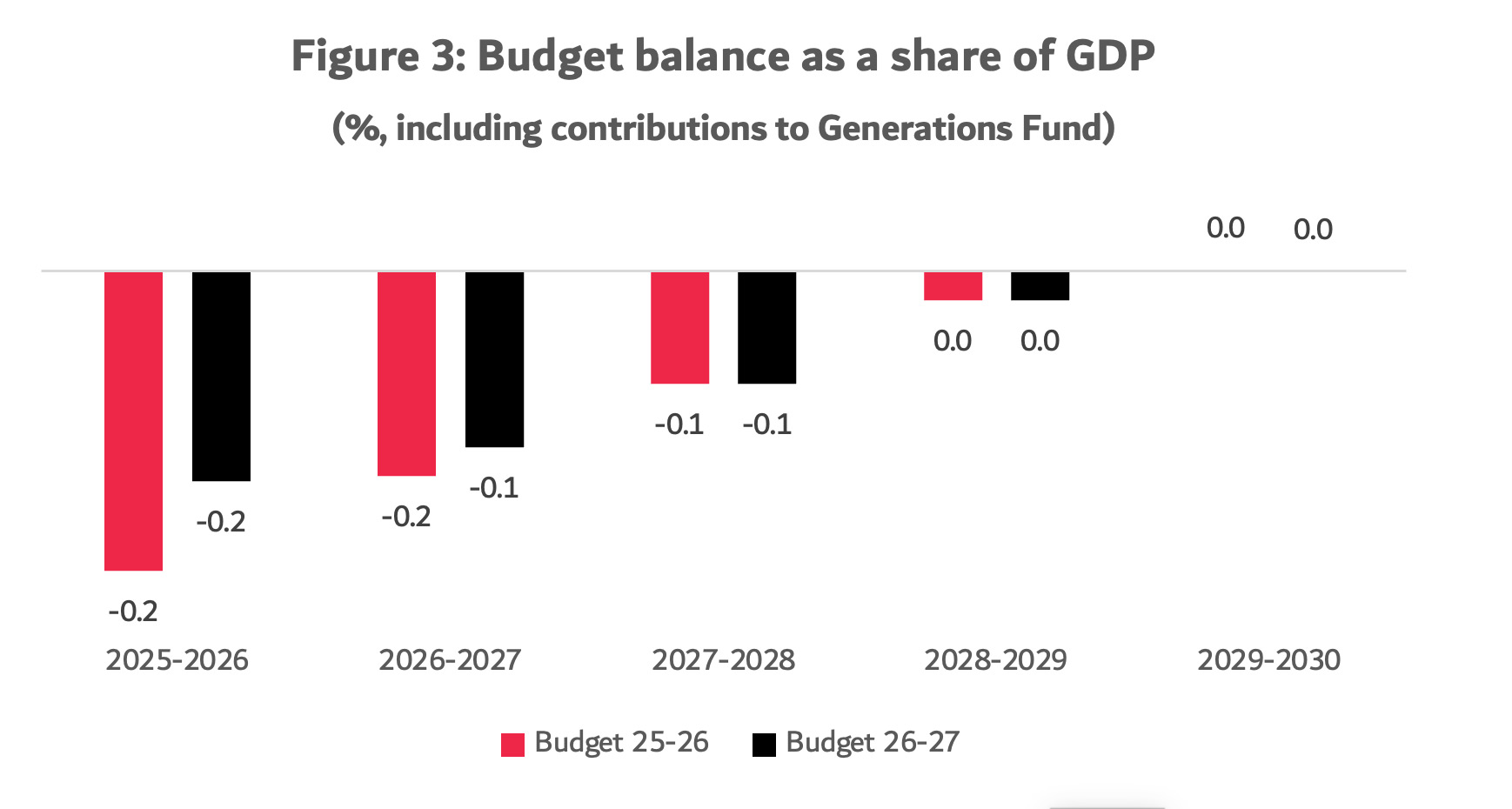
The biggest issue with Québec’s plan to bring its budget back to surpluses is that the government refuses to identify the necessary steps to reach the target in the last part of its five-year window. The plan presented last year contained “gaps to be bridged” worth up to 2.5B$ in years 27-28 to 29-30. These gaps have shrunk a bit in this year’s budget thanks to a higher baseline in 2025-2026 but the government still does not want to identify the added revenue or reduced spending that could bridge those gaps. The minister mentioned that the gaps might close on their own if the Canada-US-Mexico trade agreement is renewed and investment resumes thanks to the added certainty in the business climate.
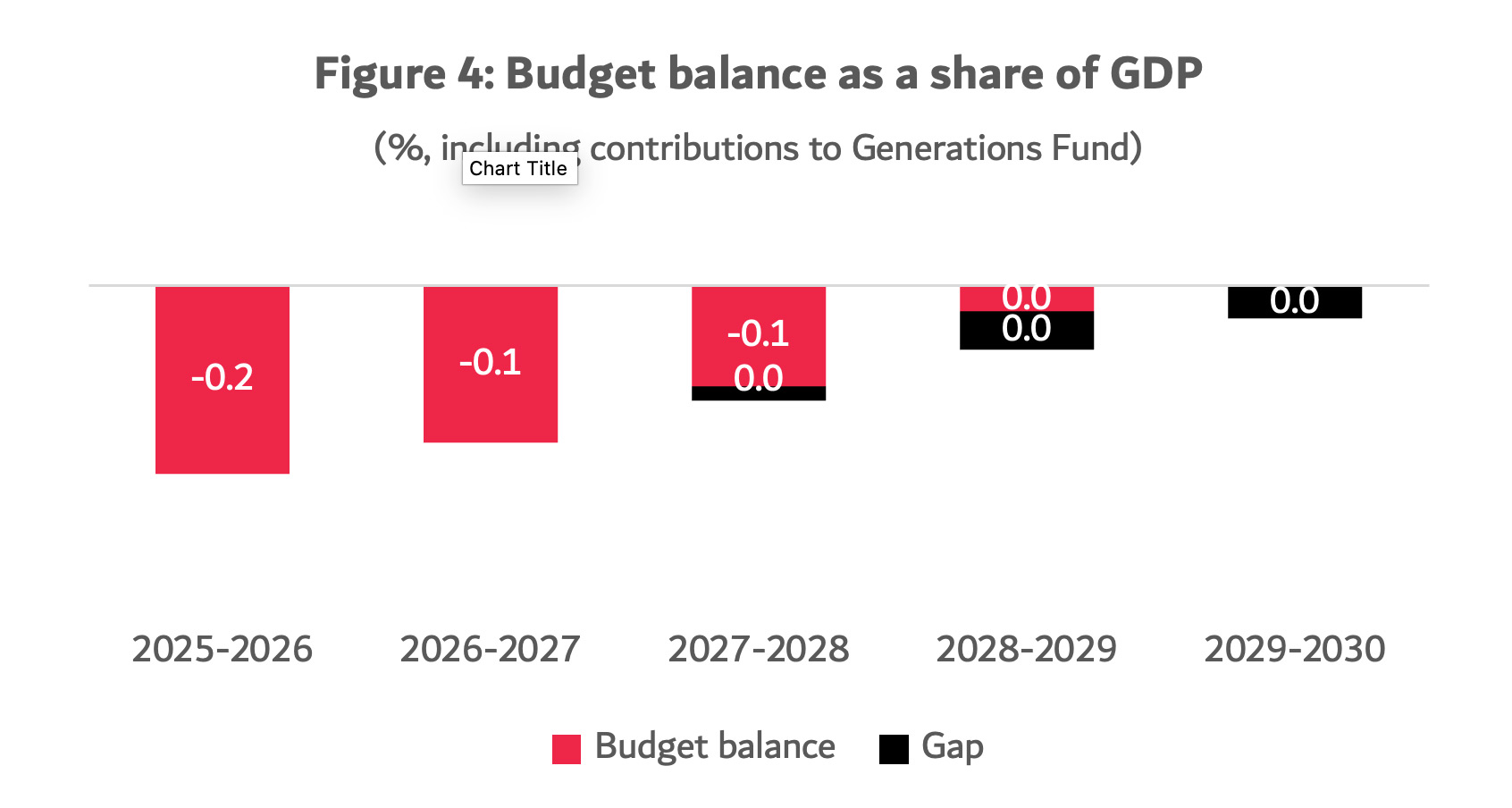
Adding to the government’s challenge is the ongoing cost of existing programs. The expenditure budget, also presented on March 18th, highlights a funding gap of at least 0.23 percent of GDP in 2027-2028. This gap sits on top of the government’s current fiscal trajectory. That is, the government assumes that program spending will be below the costs of continuation for years after 2026-2027 and still has to find up to 0.33 percent of GDP in funding or cuts. This amounts to a 3.8B$ shortfall in 2028-2029. None of these issues are new. Since 2014, finance ministers have not explicitly committed funding that covers the costs of program continuation beyond the next financial year. They have frequently met that threshold, but they have never committed to doing so in advance.
These issues matter because the province is going into an election in a few months even as the global economic climate is still very unstable. Because the new premier will be sworn in after the budget, Girard has stated that the budget contains contingencies worth at least 250M$ a year for future spending plans, likely to be unveiled over the summer. After that, electoral politics will ramp up in earnest. Parties will compete with their tax and spending proposals for 2026 to 2030. And they will do so on top of an incomplete plan to bring the budget into balance after 3 years of deficits and expected cuts to the public service coming into force during the next premier’s first year. Winning next fall’s election may not be the victory every party savours!
Related reading

After a budget, a defection, a resignation, can the Liberals survive Monday’s vote?
In this episode of the “It’s Political” podcast, host Althia Raj talks to the Canadian Tax Observatory for an overview and analysis of the federal budget, before diving into the politics of it all.

Baseball metaphors aside, this budget will be game-changing
By this time next week, the World Series will be behind us and pundits across the land will be liberated from using tortured and gratuitous baseball metaphors to explain and enlighten every element of their thinking.

Overview of the Quebec tax system – 2026 edition
An analysis led by Tommy Gagné-Dubé and Suzie St-Cerny for the Research Chair in Taxation and Public Finance at the University of Sherbrooke.
Get in Touch
Have feedback on the work we are doing? Interested in collaborating? We want to hear from you.