
An analysis from the Canadian Tax Observatory
Description and intended objectives
Budget 2026 proposes two measures under the Canada’s Growth Incentive (CGI) umbrella: a tax exemption for the first $15 million of capital gains from new shares issued by qualified Canadian businesses; and an expansion of the rollover of capital gains tax deferral when shares are reinvested in a Canadian small business.
The stated objective is to “help high-potential businesses attract investment and grow in Canada.” The budget further mentions that “(b)y allowing builders to keep more of the benefits when a business succeeds, these measures will help level the playing field with the United States, encourage more capital to flow to Canadian businesses, and enable successful entrepreneurs to reinvest their proceeds into Canada.”
Broadly speaking, the two measures are defined as follows:
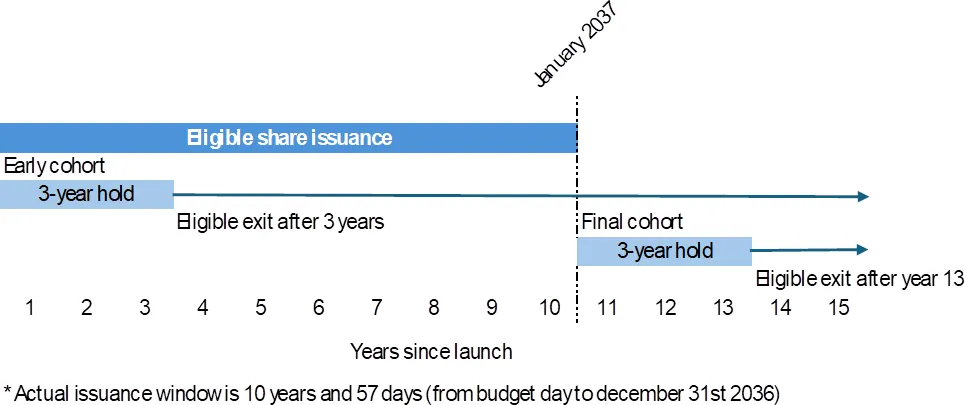
- Capital gains exemption: The measure would exempt up to $15 million of capital gains per individual, per business, from tax. It is intended to encourage investment in growing Canadian companies. It would apply to qualifying shares issued from Budget Day to the end of 2036, acquired directly from the corporation for cash or employment services, including through a partnership. Investors must be Canadian residents aged 18 or older and must hold the shares for at least three years. Purchases of existing shares from another shareholder would generally not qualify. The incentive would be subject to Canadian ownership and control requirements, limits on company assets, active-business and Canadian activity tests, broad sector exclusions, restrictions on combining exemptions, potential alternative minimum tax and further anti-avoidance rules still to be announced.
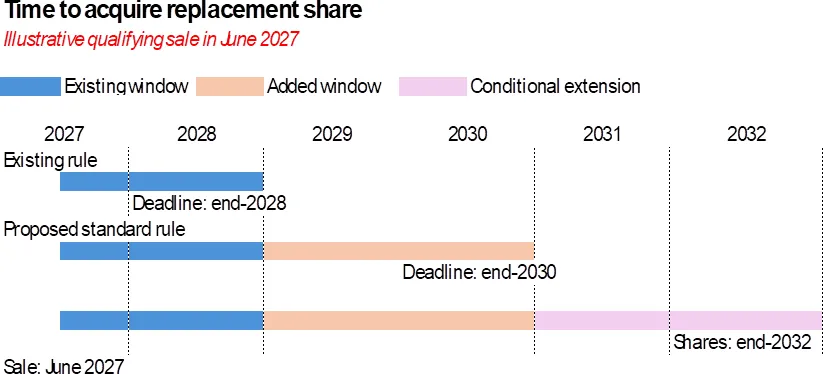
- Rollover of qualified small-business shares: The rollover defers capital gains tax when proceeds from the sale of small-business shares are reinvested in replacement eligible shares. For qualifying sales from January 1, 2027, Budget 2026 proposes extending the reinvestment window from the year of sale and the following calendar year to the year of sale and the following three calendar years. Investors who provide capital under a qualifying agreement for future equity within that window could receive another two years for shares to be issued. The budget also proposes relaxing the ongoing active-business asset test while retaining stricter tests at issuance and sale. Gains remain potentially taxable later; amounts not ultimately reinvested would become taxable, with prescribed interest applying from the original tax payment deadline if put into a capital gains reserve.
The two measures both focus on helping new and growing businesses but are set up to have slightly different impacts. The capital gains exemption increases the expected after-tax return on an investment. The rollover leaves more funds available for reinvestment These provisions could incentivize equity compensation for key employees and attract experienced investors. The response would depend on how much the current funding constraints historically faced by Canada can be addressed, or at least partly compensated, by tax relief.
Design particularities and concerns
Windfall benefits and fiscal cost
One challenge of delivering stimulus or incentives through the tax system is that eligibility generally depends on the facts and nature of those activities, rather than the taxpayer’s motivation. Unlike a funding program that requires an application, evaluation and approval, tax incentives generally operate without advance assessment of individual claims. This reflects the tax system’s broader purpose of giving taxpayers reasonable certainty about the tax consequences of their decisions, helping them plan their activities. As a result, in some circumstances taxpayers will receive windfall gains from incentives that reward activities they would have undertaken anyway.
To a certain extent, the capital gains exemption restricts these windfall gains by limiting eligibility to newly issued shares, with no relief for existing holdings. That said, it would benefit investments already planned or commercially attractive without support. As such, some CGI relief will go to investments and entrepreneurial activity that would have occurred without the capital gains exemption, creating a deadweight fiscal cost.
The budget’s projected $485 million cost in 2030-31 for the capital gains exemption does, by itself, identify this share. A credible estimate would require evidence about investment, business formation and growth relative to what would otherwise have happened. This fiscal cost should also be distinguished from potential economic loss (i.e. the move of investment to a less productive area).
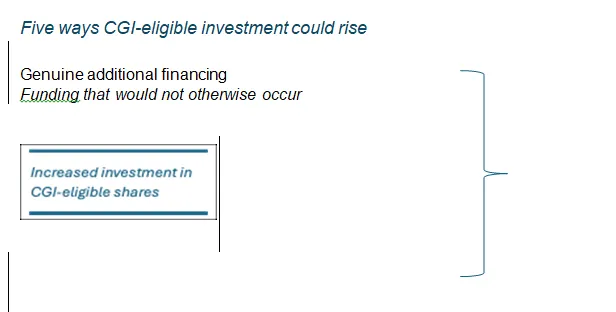
from foreign assets
Funds redirected from investment abroad
Shift within Canada
Funds moved from other Canadian investments
Investment brought forward
Planned investment made sooner
Restructured financing
Existing arrangements changed to qualify
These responses have different implications. Moving capital from abroad could expand the financing available in Canada, while switching it between Canadian businesses might mainly redistribute it. Bringing investment forward could provide a temporary stimulus without increasing its longer-term total, and restructuring could increase claims without changing any underlying activity. Evaluation should therefore distinguish qualifying equity subscriptions from additional business investment and economy-wide capital formation.
Reallocation can still improve productivity if capital reaches more productive uses, but that benefit must be demonstrated separately from an increase in eligible investment.
Productivity effects
The strongest productivity case is that higher prospective after-tax returns encourage financing, entrepreneurial effort and employee participation in businesses that develop better products, adopt technology or scale efficient operations. Qualifying shares must have been issued either solely for cash consideration or in exchange for employment services, accommodating both financial investment and employee participation. Eligibility for shares issued for employment services could make equity compensation more attractive, helping firms recruit and retain skilled employees who contribute to innovation and productivity. The new-share requirement, the three-year minimum holding period and the business-asset conditions are consistent with supporting financing and sustained business activity that can generate productivity over time. However, higher company valuations and successful exits do not automatically establish productivity gains. The economic benefit will depend on whether the incentive helps overcome a financing constraint or changes business decisions in ways that increase output per worker or improve the allocation of resources. Benefits could also extend to other firms through knowledge and technology spillovers.
The exemption’s published conditions do not require sale proceeds to be reinvested, so further domestic investment after an exit should be treated as a possible behavioural response rather than an assured outcome.
Potential use beyond the intended purpose
The exemption creates incentives to arrange ownership, financing and business structures around eligibility. Finance Canada explicitly anticipates this risk. It points to the possibility of the exemption being multiplied across several corporations carrying on the same underlying business, and says: “Details of these rules will be released at a later date.”
Other questions include how the rules will distinguish separate businesses, accommodate legitimate reorganizations and prevent ordinary earnings or existing economic value from being repackaged as exempt gains. Specific issues to watch for include growth-share planning, how the announced limits on claiming both the CGI Capital gains and the Lifetime Capital Gains Exemption for shares of the same corporation will operate in practice, and whether interactions with the rollover rules could create unintended benefits. These are potential design vulnerabilities, not evidence that particular arrangements will succeed or constitute abuse. The eventual integrity rules will help determine both the exemption’s fiscal exposure and the compliance burden associated with using it.
Exclusions, sectors and ownership structure
are ineligible, and business exclusions cover professional practices, consulting, real estate, finance and insurance, several resource and service sectors, and businesses operating under licensing or franchising agreements. The budget frames the CGI as supporting innovation and high-potential businesses, a focus that aligns with technology and manufacturing while also encompassing eligible businesses in other sectors. A plausible rationale is to concentrate relief on scalable businesses facing risk-capital constraints, while limiting support for property appreciation, established income-generating activities and opportunities to convert professional earnings into exempt gains.
Excluding trusts may also simplify attribution and limit ownership-based planning. (These explanations are analytical interpretations, not a documented justification for every exclusion.)
Broad sector boundaries can exclude innovative, productive businesses while admitting less productive firms elsewhere, and can create uncertainty for businesses with mixed activities. The policy question is whether sector classifications accurately identify the financing problem being addressed, and whether the gains from targeting outweigh the resulting distortions and complexity.
Fiscal window
The five-year costing for the capital gains exemption captures only the beginning of its fiscal impact.
Costs first appear in year four, at $80 million, before jumping to $485 million in year five (2030–31). Approximately 86 per cent of its $565 million total falls in the final year. This delay reflects the minimum three-year holding period before qualifying shares can be sold. Consequently, the five-year total, and especially its $113 million annual average, gives a poor indication of the exemption’s potential ongoing cost. Nor should the fifth-year estimate automatically be treated as its fully mature annual cost. The budget does not provide projections beyond that year or indicate whether this represents the exemption’s mature annual cost.
The lifetime cost of both measures cannot be established from the published forecast, but one would expect that it will be substantial. The end of 2036 is a cutoff for issuing qualifying shares under the exemption, rather than a deadline for claiming it; qualifying investments could therefore generate fiscal costs well beyond that date. The rollover enhancement, meanwhile, has no stated sunset. Its cost also differs fundamentally: an exemption permanently forgives eligible tax, whereas a rollover postpones collection, potentially allowing subsequent revenue recovery while imposing a financing cost on government.
An assessment should therefore extend beyond 2036 and distinguish permanent revenue losses from delayed receipts. There will likely be pressure to extend the exemption’s issuance window to maintain support for new investments, although any extension remains a future policy choice.
The two measures together reduce federal revenues by $715 million within the forecast window, including $525 million in 2030-31. All else being equal, these fiscal losses increase deficits and accumulated debt, with additional debt-service costs over time. Their delayed onset limits the immediate deficit impact but leaves future budgets carrying more of the burden. Additional investment and growth could recover some revenue, but only to the extent that the CGI genuinely induces new activity. The measures should not be assumed to pay for themselves.
Economic assessment
What the evidence establishes
Most of the evidence relevant to the CGI’s capital gains exemption comes from the study of a similar American measure, the Qualified Small Business Stock (QSBS) tax benefit, which was expanded in 2010 to provide a 100% exemption for eligible capital gains. Research shows approximately 12% higher startup funding and 10% more firm births in QSBS-eligible industries relative to comparison groups following the 2010 expansion[i]. These findings support the possibility of an investment response. They do not provide a forecast for Canada or establish how much activity is additional rather than accelerated, or whether it produces lasting productivity and growth benefits.
How the benefits are distributed deserves equal attention. found that taxpayers with average total positive income above US$1 million accounted for nearly 75% of QSBS gains excluded over 2012 to 2022. Canada’s budget also anticipates that direct beneficiaries of the capital gains exemption (founders, early-stage employees and investors) will be concentrated among higher-income individuals, with an adjusted gross income exceeding C$200,000. Concentrated benefits do not rule out broader economic gains, but because the direct benefits go to a limited group of Canadians, evidence of those broader gains is particularly important.
A broader review by Hourani and Perret (2025)[iii], published in the OECD Taxation Working Papers series, puts these findings in perspective. The authors find mixed evidence that favourable capital gains taxation increases aggregate saving, entrepreneurial activity or economic growth. They identify stronger, although still limited, evidence that it can encourage external financing of young firms. For the CGI, then, the more substantiated case is that the relief could attract financing to businesses facing capital constraints. Broader claims about business creation, productivity and Canadian incomes, would require additional evidence.
The authors also argue that upfront tax (or non-tax) support may address some entrepreneurial constraints more directly than relief received upon a successful exit. An assessment should therefore consider whether the CGI generates more additional investment and economic benefit than alternative uses of the same fiscal resources.
The economic case ultimately depends on whether the CGI changes decisions.
Additional financing could help viable firms develop products, commercialize research and expand in Canada. Successful expansion could generate taxable wages, corporate profits and consumption, recovering some of the initial revenue loss. But investment that would have occurred anyway produces a tax benefit without the same incremental economic return. Funding redirected from other Canadian businesses must also be assessed against the activity displaced. More financing and more firms are useful indicators, but the stronger test is whether the measure improves productivity and raises Canadian incomes over time.
Unless offset elsewhere, those losses increase deficits and debt, so both require assessment beyond the five-year window. Over the longer horizon, some revenue recovery through growth is plausible, but the available evidence does not establish that either measure would pay for itself.
The CGI’s Economic Potential and Trade-offs
Unlike the Productivity Mega Deduction (PMD), for which the government published estimates of increased GDP and employment, the CGI has no comparable published estimate of additional economic activity. That leaves an important question unanswered: how much additional investment and growth will the tax relief generate?
| Potential advantages | Potential drawbacks |
| Encourage creation of new startups | Creates unequal tax treatment across investments, steering capital towards qualifying companies |
| Encourage new investments | Can reward investments that would have occurred anyway |
| May support innovation and risk-taking | Benefits can be highly concentrated |
| Favourable treatment of employee-held shares can help recruitment | Offers limited immediate help to struggling companies |
| Improves competitiveness with the U.S., with a tool that can provide similar benefits to the QSBS | Creates tax planning opportunities |
Conclusion
The Canada Growth Incentive has the potential to drive new investment and boost productivity, but careful design is crucial to prevent unintended consequences. Finance Canada has not yet written the provisions into legislation and has indicated that further integrity rules will follow, including provisions addressing multiple corporations carrying on the same underlying business.
As the legislation takes shape, areas that will need close attention:
- Reorganizations and growth-share planning;
- Safeguards needed to ensure cash subscriptions represent net new funding;
- multiple corporations that carry on the same underlying business to artificially multiply the exemption; and
- the implementation of the announced limits on claiming the CGI and Lifetime Capital Gains Exemption, alongside coordination with the rollover rules.
The concern is that transactions could make existing value, deferred gains, capital recycling or artificial multiplication of the exemption eligible for the CGI without bringing meaningful new capital into the business.
Clear guidance will also be needed on business sector eligibility, particularly for firms that combine technology, consulting, professional services and intellectual property. These cases may be difficult to resolve through legislation alone, making practical examples and administrative guidance especially useful. For equity compensation, existing employment-benefit rules already address many income-conversion concerns. Guidance explaining how those rules interact with the CGI may be as important as additional legislation.
Finally, proportionate reporting at share issuance, through either a Statistics Canada survey or Canada Revenue Agency reporting, followed by a scheduled evaluation, would help identify emerging risks and assess whether the measure delivers additional investment, innovation and economic activity in Canada. That said, we should be careful not to overburden the businesses the regime is meant to support.
Achieving the government’s objectives depends on whether the tax relief actually changes investment and business decisions that attract additional capital to Canada, direct existing capital toward more productive uses, encourage entrepreneurs to build and expand businesses here, and all of it at a reasonable fiscal cost.
[1] Chen, Jun, and Joan Farre-Mensa, 2026, Capital Gains Tax Relief and Entrepreneurship: Evidence from the
QSBS Exemption, Working Paper. https://papers.ssrn.com/sol3/papers.cfm?abstract_id=4482626
Campello, Murillo, and Junqueira, Guilherme, 2026, TAX INCENTIVES AND VENTURE CAPITAL RISK-TAKING:
EVIDENCE FROM THE QSBS PROGRAM, NBER Working Paper 35418, NATIONAL BUREAU OF ECONOMIC RESEARCH, http://www.nber.org/papers/w35418
Edwards, Alexander, and Maximilian Todtenhaupt. 2020. “Capital Gains Taxation and Funding for Start-Ups.” Journal of Financial Economics 138(2): 549–571. https://doi.org/10.1016/j.jfineco.2020.06.009. Working-paper version consulted: SSRN.
[1]Abdulrauf, Zahrah, Gerald Auten, Paul R. Organ, and Quinton White. 2025. Quantifying the 100% Exclusion of Capital Gains on Small Business Stock. Office of Tax Analysis Working Paper No. 127. U.S. Department of the Treasury, January 16. https://home.treasury.gov/system/files/131/WP-127.pdf.
[1] Hourani, D., and S. Perret (2025), “Taxing capital gains: Country experiences and challenges,” OECD Taxation Working Papers, No. 72, OECD Publishing, Paris, pp. 21–24, 32 and 48. https://doi.org/10.1787/9e33bd2b-en
Related reading

The Productivity Mega Deduction: the benefits, the risks and the many outstanding questions
Calling it a “deduction” understates the scale of the change. Here’s an explainer and analysis by the Observatory’s senior economist Jean-François Ruel

Hitting Snooze on the Tax Bill: Understanding tax deferrals in Canada
Tax deferrals let Canadians act now and pay tax later, but they don’t always serve their purpose. Hitting Snooze on the Tax Bill sorts Canada’s tax deferrals into seven families and sets out where closer scrutiny is needed: capital gains, passive corporate investments and estate arrangements.

Mark Carney’s tax-cutting spree has cost Canadians billions for small gains and dubious results
Carney has made several forays into the world of tax cuts since he became PM, in the name of easing affordability pressures and reordering the Canadian economy to deal with global disruption…. After a year of tax cutting, the impact on Canadian well-being is worth assessing.
Get in Touch
Have feedback on the work we are doing? Interested in collaborating? We want to hear from you.