
Read the press release
When does paying tax later help Canada’s economy?
Tax deferrals are a popular tool meant to encourage Canadians to save, spend or invest, but they don’t always serve their intended purpose.
That’s why the Canadian Tax Observatory set up a system to analyze when taxpayers are allowed to defer payment, under what conditions, and what happens to the economy as a result. In Hitting Snooze on the Tax Bill, we codify whether tax deferrals are pushing our economy in a more productive direction that serves the Canadian public.
Tax deferrals allow individuals and businesses to act now and pay their taxes later, and there are many different varieties serving different purposes.
Deferrals are involved in the tax treatment of retirement measures, capital gains, rollovers and capital costs. Deferrals for retirement savings are straightforward. But deferrals for capital gains, rollovers and capital costs give firms and individuals more flexibility on when, or even if, they eventually pay.
Some deferrals encourage active investment in new economic activity and Canada needs that right now. But some deferrals make passive investment more lucrative, and that’s the last thing we need right now. And some deferrals interact with each other, allowing a perpetual dodging of the tax bill.
By sorting them out in a rigorous way and ensuring the system is fair and focused on productivity, we now know where to focus greater scrutiny for the next phase of our research: capital gains, passive corporate investments and estate arrangements.
Here’s our executive summary, full report and infographics.
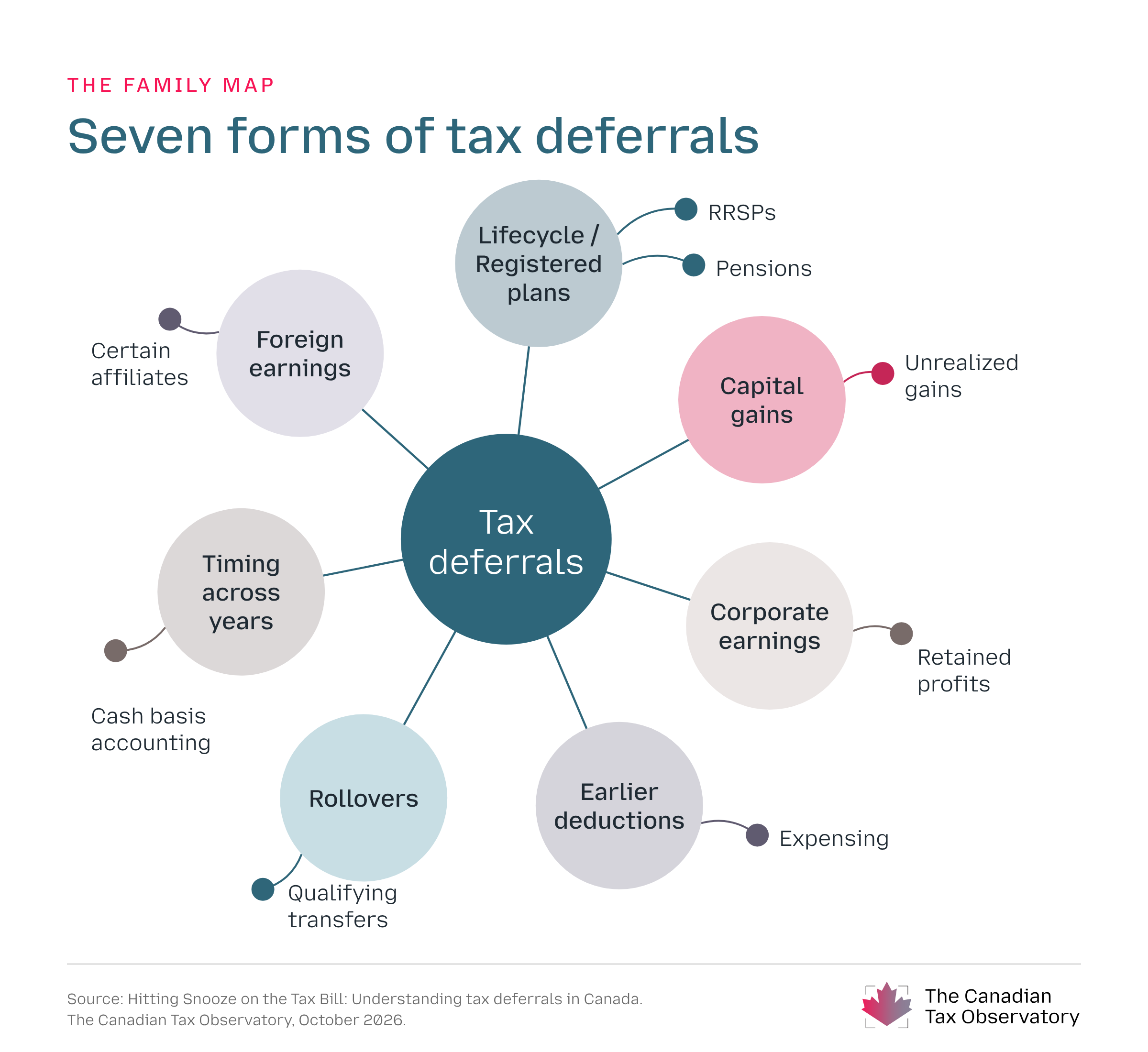
The family map: seven forms of tax deferral.
Four main findings
Deferrals serve different purposes.
Retirement measures are meant to help people save and spread income over their lives, while taxing capital gains when assets are sold is supposed to help align tax payments with available cash. Rollovers may ease changes in ownership or legal structure, and accelerated deductions are designed to encourage investment. Each should be judged against its purpose.
The length of the delay and control over its timing matter.
Some accelerated deductions reverse fairly quickly, while unrealized capital gains and retained corporate earnings can defer personal tax for years, with taxpayers often choosing when to trigger it. Retirement plans also offer long deferrals, but contribution limits and mandatory withdrawals restrict that flexibility. Each should be assessed against both its duration and the control it gives taxpayers.
How the money is used matters as much as how long tax is postponed.
Retained earnings can help a business buy equipment, expand or cover future expenses. They can also fund passive investments that provide a reserve for the business and finance activity elsewhere. Each use should be assessed against the deferral’s purpose and whether it encourages investment that would otherwise not occur.
Tax provisions need to be examined together.
Corporate ownership, capital-gains rules, rollovers and trusts can interact to extend deferrals or change the eventual tax outcome. Looking at each provision separately can miss these broader effects.
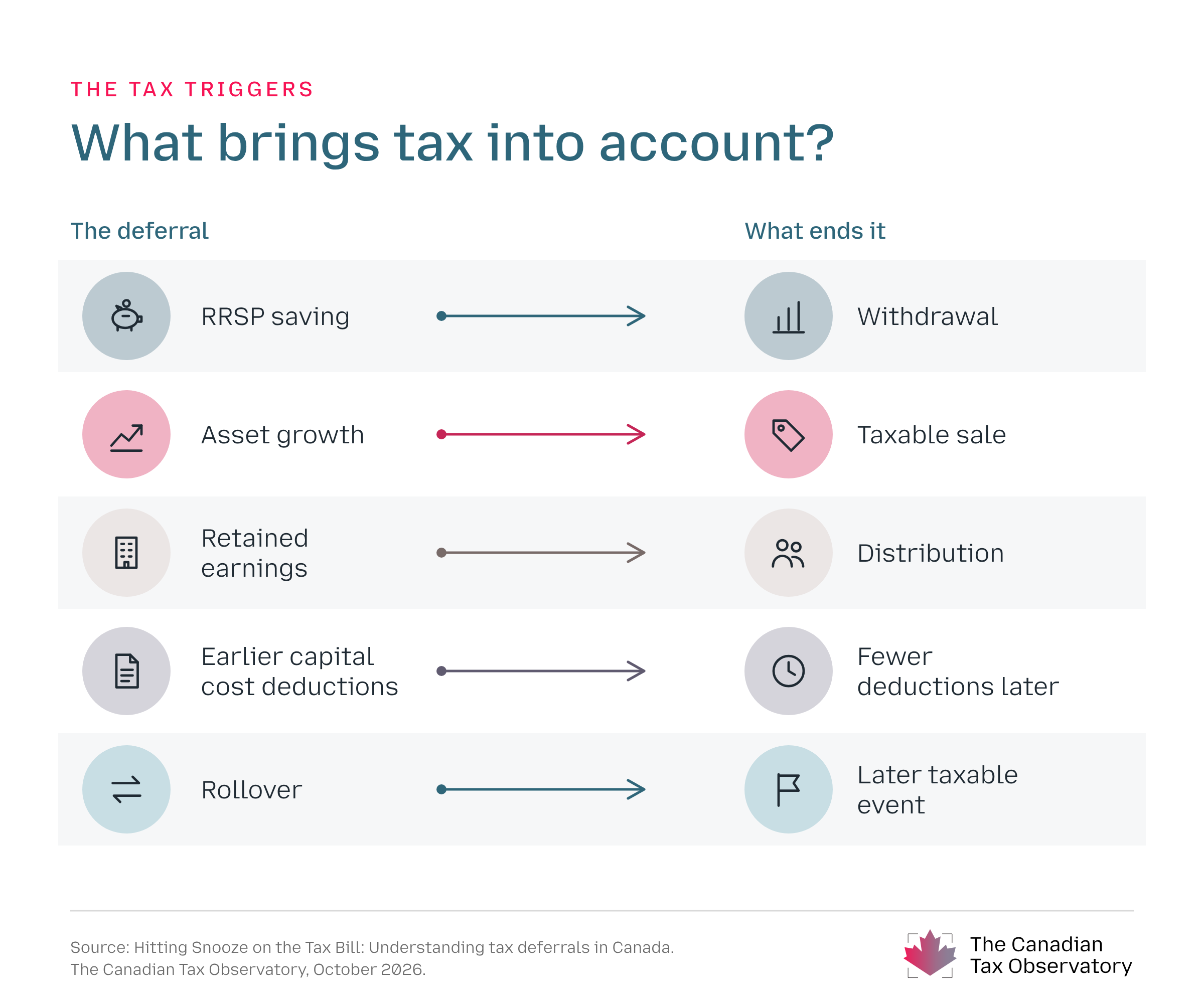
The tax triggers: what eventually brings deferred tax into account.
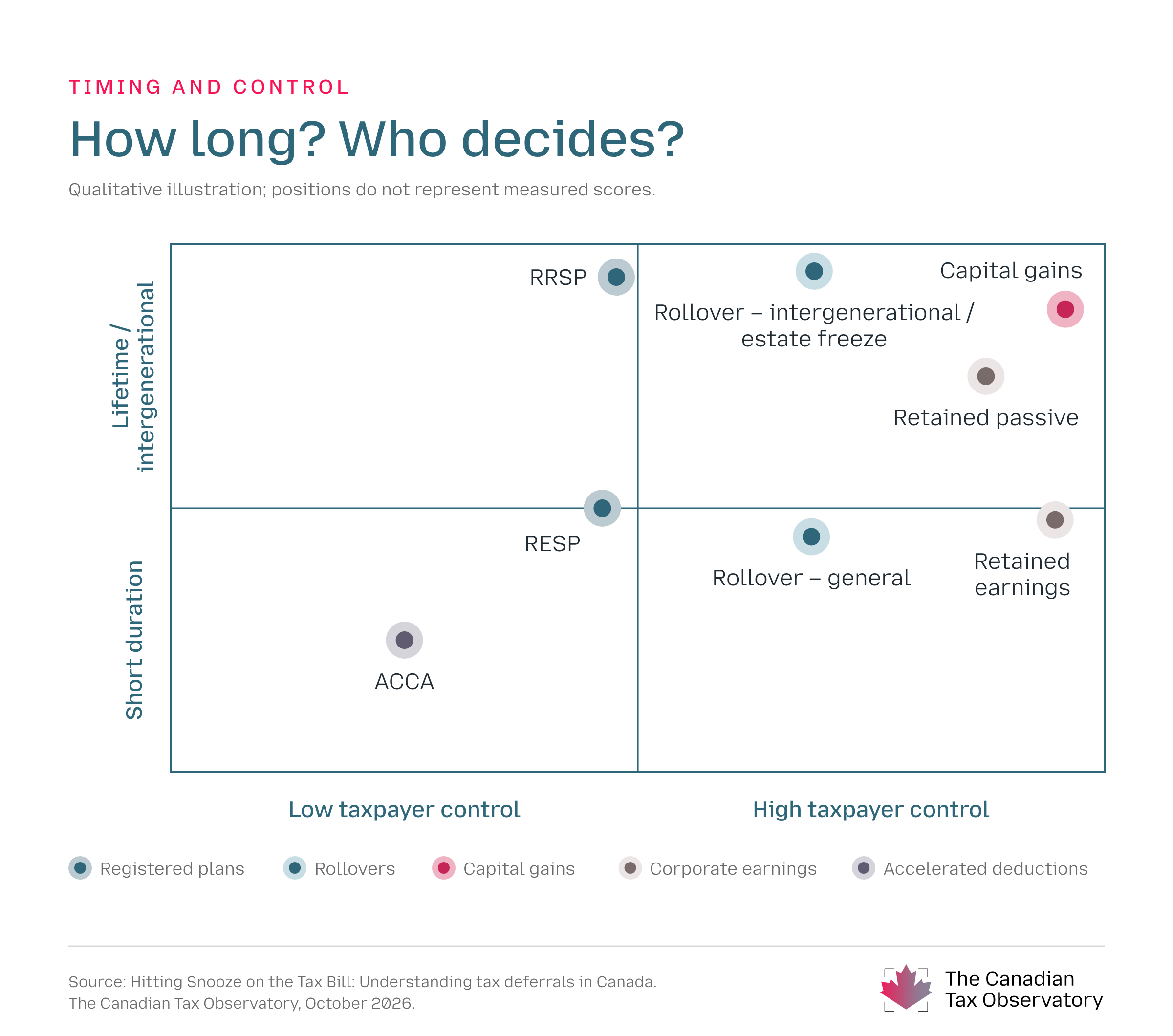
Timing and control: how long tax can be deferred, and how much say the taxpayer has over when it ends.
These findings point toward a second phase of research focused on the value of selected deferrals, who benefits and what they achieve. Priorities include capital gains, retained corporate earnings and passive investments, and selected rollover and estate arrangements. Accelerated cost recovery would offer a useful comparison because eligibility is directly tied to qualifying investment.
That research would also consider options to simplify the system. The aim would be to preserve justified relief while assessing whether existing arrangements deliver benefits that warrant their costs in revenue, complexity and fairness.
Français
Principales conclusions
Les reports d’impôts ne répondent pas tous aux mêmes objectifs.
Les mesures relatives à l’épargne-retraite sont conçues pour aider les particuliers à épargner et à répartir leurs revenus tout au long de leur vie, tandis que le report de l’imposition des gains en capital au moment de la vente des actifs vise à leur permettre de payer l’impôt correspondant quand ils ont les liquidités pour le faire. Les roulements fiscaux peuvent faciliter les changements de propriétaire ou de structure juridique, et les déductions accélérées visent à encourager l’investissement. Chacune de ces mesures doit être évaluée au regard de son objectif.
La durée du report et la possibilité d’en choisir l’échéance sont importantes.
Certaines déductions accélérées se traduisent par un report relativement court. L’impôt sur les gains en capital et les bénéfices non distribués des entreprises, en revanche, peut être reporté pendant des années, et c’est souvent le contribuable qui décide jusqu’à quand. Les régimes d’épargne-retraite permettent eux aussi de reporter l’impôt sur de longues périodes, mais la marge de manœuvre est moins importante en raison des plafonds de cotisation et des retraits obligatoires. Chacune de ces mesures doit être évaluée en fonction de la durée du report et de la latitude offerte au contribuable.
L’utilisation qui est faite des fonds est tout aussi importante que la durée du report d’impôt.
Les bénéfices non distribués peuvent servir à financer l’achat d’équipement, la croissance de l’entreprise ou ses dépenses futures. L’entreprise peut aussi les investir dans des placements passifs pour se constituer une réserve financière et financer d’autres activités. Il convient d’évaluer chaque utilisation au regard de l’objectif du report et de déterminer si celui-ci favorise la réalisation d’investissements qui n’auraient autrement pas lieu.
Les dispositions fiscales doivent être considérées dans leur ensemble.
Les effets conjugués de la structure de propriété des entreprises, des règles sur les gains en capital, des roulements fiscaux et des fiducies peuvent prolonger les reports d’impôt ou modifier le montant d’impôt qui sera finalement dû. Si on évalue chacune de ces dispositions séparément, on risque de passer à côté.
Ces constats ouvrent la voie à une deuxième phase de recherche qui portera sur la valeur de certains reports d’impôt et visera à déterminer à qui ils profitent et quels sont leurs effets. Nous nous intéresserons en priorité aux gains en capital, aux bénéfices non distribués des entreprises et aux placements passifs, ainsi qu’à certains mécanismes de roulement fiscal et à certaines dispositions successorales. La déduction pour amortissement accéléré offrirait un point de comparaison intéressant, puisque l’admissibilité à cette mesure dépend directement de la réalisation d’investissements admissibles. Il s’agira de déterminer si elle favorise de nouveaux investissements, incite les entreprises à devancer des dépenses prévues ou profite surtout à des dépenses qui auraient été engagées de toute façon.
Related reading

Housing Tax Policy in Canada
Research examining the impact of housing tax incentives—particularly the FHSA—on Canadian affordability. As more savings from affluent families flow into tax-sheltered accounts, there’s a cost to everyone else.

Yes, Canada needs investment. No, slashing corporate tax rates is not the answer
Those of us who make a habit of sifting through government speeches and documents in search of clues for the upcoming federal budget can safely assume: this year, it’s all about investment.

Tax havens cost Canada some $15 billion a year in revenue. Is Ottawa’s crackdown working?
Canadian parliamentarians are taking a crack at squeezing out more government revenue from tax havens, and we wish them all the luck and stamina. Tucked away from the Conservative-to-Liberal floor-crossings and the nail-biting confidence-vote drama that have dominated this Parliament, MPs on the House of Commons finance committee were contemplating all the places where corporations put their profits.
Get in Touch
Have feedback on the work we are doing? Interested in collaborating? We want to hear from you.